Psychosocial development, from the earliest years of life, shapes the connection between a child’s “inner states” and his or her “external relationships,” and ultimately determines the emotional, social, and cognitive skills that remain dependable in adulthood. This process is staged; however, the stages are not separate, and the quality of interactions with family and school can change the pace of development, the scope of learning, and even stable patterns of behavior. Scientific examination of this topic in developmental psychology, social psychology, and cognitive psychology helps show how human skills are built—and why, alongside talent, the environment plays a decisive role.
Psychosocial Development; From a Need for Security to the Ability to Communicate
Developmental psychology shows that in each period, a child faces specific needs and challenges. Part of these challenges is related to mental mechanisms—such as language learning, attention, decision-making, and emotion regulation—while another part is related to social interactions—such as the formation of attachment, following group rules, and managing conflict. In each period, if the environment allows the child to practice and receive healthy feedback, the child gradually internalizes skills that help them function more successfully in future situations.
From the perspective of personality psychology, these skills are not merely momentary behaviors; over time, they become dominant response styles. Social psychology also makes it clear that “what others do” places the child on a specific path: encouragement or blame, consistency or inconsistency, the possibility of dialogue or the complete prohibition of expressing feelings—all of these play a role in building skills.
Key Stages of Psychosocial Development
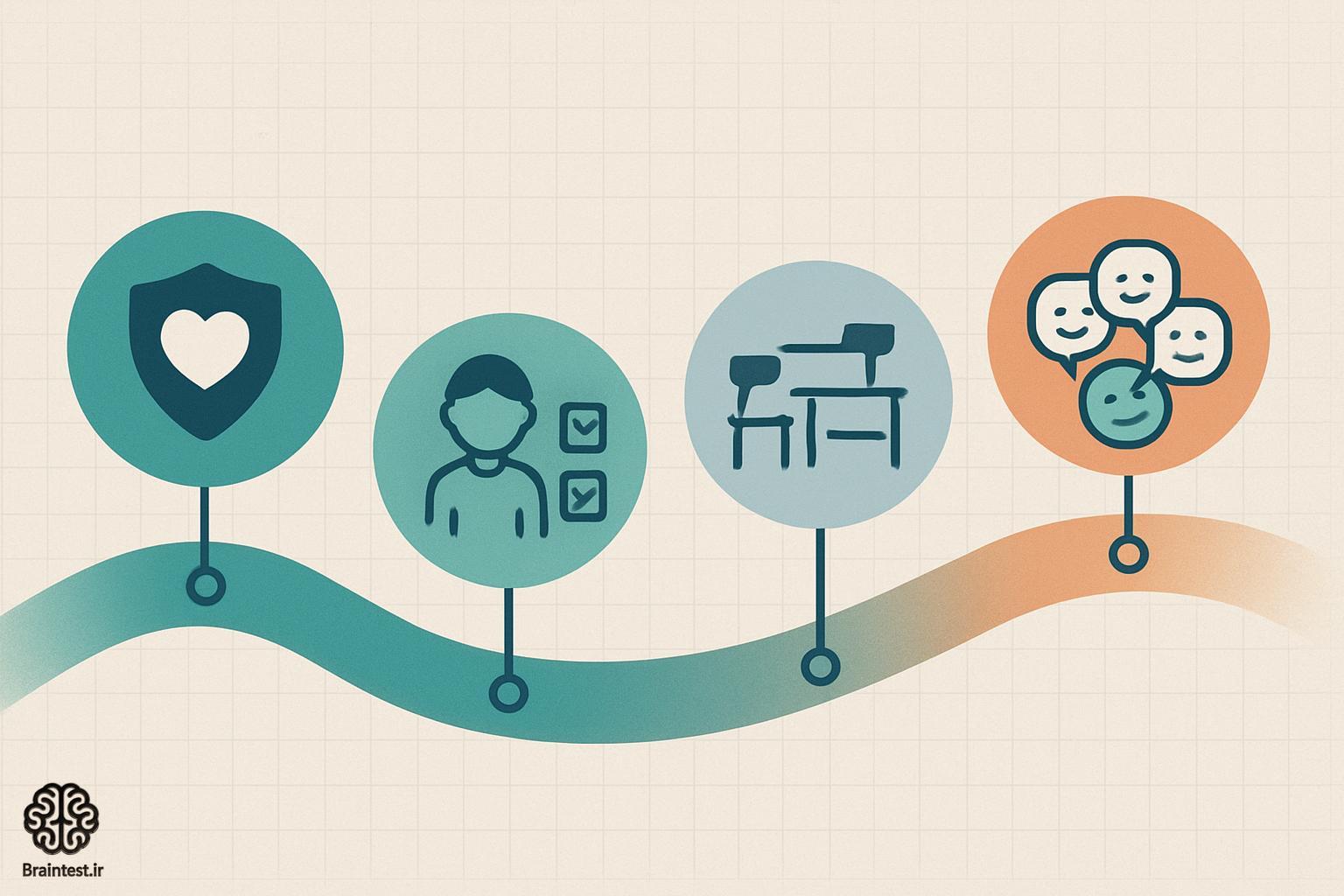
For a coherent understanding, we can summarize development across several time-based axes. In this framework, each stage is accompanied by a central issue—success in it paves the way for the next stage.
1) The early years: Attachment, security, and emotion regulation
At the beginning of life, a child needs security and responsiveness more than anything. Ongoing care—food, soothing, attending to physical needs, as well as attention to emotional cues—forms the foundation of trust. From a cognitive psychology viewpoint, these repeated responsive reactions create early mental maps: the child learns that the world is predictable and that feelings are neither worthless nor dangerous.
In this stage, foundational skills such as calming down, tolerating brief frustration, and forming initial relationships take shape. The quality of family interaction is decisive here. If needs are constantly ignored or reactions are intense and unpredictable, the likelihood of problems in emotion regulation and the development of persistent anxiety increases.
2) Early childhood: Autonomy, behavior control, and early rules
As development continues, the child encounters new abilities and the desire for independence increases. The foundation for skills such as simple decision-making, carrying out short instructions, and experiencing behavioral consequences is laid during this period as well. Within developmental psychology, the transition from full dependence to relative autonomy requires “boundaries”—meaning that both support and structure are present.
In this phase, the family typically faces two common mistakes: either excessive control that prevents opportunities to practice independence, or excessive permissiveness that leaves the child without guidance in difficult situations. School, too, can support the formation of disciplinary and social skills when it provides clear, understandable rules from the start, along with consistency.
3) School age: Motivation, cooperation, and social identity
With entry into school, the circle of relationships expands, and the child must work within peer groups. Social skills such as taking turns, cooperating, resolving conflicts, and understanding group rules become more prominent. At the same time, cognitive skills—such as focus, simple planning, and learning problem-solving strategies—grow through interaction with educational tasks.
From a social psychology perspective, school is an environment where “comparison” and “evaluation” take place. How the child’s performance is responded to can shift the direction of development. Feedback that emphasizes effort, the learning process, and the possibility of improvement typically helps increase self-efficacy and reduce fear of failure. In contrast, labeling and constant comparisons can lead to the development of fear of judgment and a decline in motivation.
4) Adolescence: Forming identity, real independence, and managing social pressures
Adolescence is the stage in which the need for independence blends with peer pressure, family expectations, and new emotional experiences. Personality and social psychology show that in this period, identity is actively constructed: the adolescent tries to find their values, roles, and behavioral style. At the same time, managing emotions and controlling impulses becomes even more important.
In adolescence, the family needs more than direct control; it needs “non-threatening dialogue” and “preserving respect.” School can also provide the conditions for practicing healthy social roles through teaching life skills, counseling programs, and participatory activities. When pressures are not managed, the likelihood of maladaptive patterns in emotion regulation and social relationships increases.
The Role of the Family: Building Skills, Not Just Observing Behavior
Family is the first arena where skills are practiced, and its role cannot be summarized only as “discipline.” The family shapes skills through several main pathways:
Emotional interaction model
Children learn from everyday behaviors how to express anger, worry, happiness, and sadness. If the family responds to emotions in a balanced way, the child learns not to suppress feelings and, at the same time, learns emotion control.
Parenting style and boundary-setting
Clear boundaries—not strict and not overly lenient—help the child see rules as a “life framework” rather than “threat tools.” In this situation, self-regulation skills, following rules, and managing frustration grow.
Dialogue and feedback
Feedback that explains why a behavior is acceptable or changeable strengthens the cognitive skill of “understanding consequences.” The child doesn’t just learn to obey; they also understand the reasons. This type of learning has a lasting impact on future problem-solving and decision-making.
Stability and predictability
Family stability helps reduce tension and increase security. When rules and reactions are consistent, the child spends less mental energy guessing and worrying, and more energy on learning skills.
The Role of School: Turning Skills into Practical Abilities
School is a multilayered environment in which children experience skills through real performance. The role of school can be seen across several areas:
Direct teaching of social and emotional skills
A significant portion of skills is built through “practice,” not merely advice. Educational programs that cover group work, recognizing emotions, conflict resolution strategies, and effective communication can support the development of social skills. This becomes more effective when it aligns with the school culture and how mistakes are handled.
Classroom management and the quality of the teacher-student relationship
The teacher is not only a transmitter of content; they also play a role in regulating interactions. Respectful behavior, fairness in evaluation, and creating opportunities for participation in class build trust and reduce risky behaviors. Clinical psychology also emphasizes that supportive educational environments are less likely to intensify emotional problems.
Educational evaluation and feedback
Educational feedback should show the child where the improvement path lies. Focusing on the “process” and “progress compared to the past,” rather than emphasizing the final outcome, strengthens motivation and resilience. This is also important in cognitive psychology, because a person’s belief in their ability to learn affects their effort and cognitive strategies.
Communication between school and family
When information and approaches are aligned, children do not receive conflicting messages. Consistency in boundary-setting, the way encouragement is given, how errors are addressed, and even educational expectations reduce psychological pressure and increase opportunities to practice skills.
Psychological Link Between Family and School: Why Is Synergy Important?
Psychosocial skills take shape when the messages from the environment move in the same direction. The family provides the “emotional roots and relationship style,” and school provides “the opportunity to practice in a group and turn learning into functional skill.” If these two institutions are not aligned—for example, if a behavior is permitted at home but in school the same behavior is met with harsh punishment—the child becomes confused and tension increases. This tension can affect focus, motivation, and the quality of relationships.
Also, control and interaction styles can inspire one another. If school can transfer supportive and educational approaches to the family, and the family can adjust behavioral consistency within the framework of the school, the likelihood of forming more stable skills increases.
Summary
Psychosocial development is a staged path in which, in each period, a different central issue is presented; from attachment and security at the beginning of life to autonomy in childhood, cooperation and social identity in school years, and managing social pressures in adolescence. Emotional and social skills, as well as cognitive abilities, are shaped through continuous interaction with the environment, and family and school are the two main pillars of this process. With emotional security, balanced boundary-setting, consistency, and constructive feedback, the family creates the conditions for emotion regulation and relationship patterns. With teaching emotional-social skills, classroom management, educational feedback, and opportunities for participation, school turns learning into practical abilities. The final result is that the synergy of these two institutions makes the path of growth clearer and the skills more stable—and it is exactly this alignment that has the greatest impact on the formation of psychosocial skills in a child’s and adolescent’s life.